Showing posts with label Mellingham series. Show all posts

Friday, January 28, 2022

Getting through the First Draft

Recently I posted a comment on FB that I had reached 57,000+ words in my work-in-progress and now, at last, knew how it was going to end. This sounds absurd to anyone but another writer, and has become more and more likely in my work. 

When I began writing the Mellingham series in the 1990s, I knew who the killer was, the motive, and how the final scenes would play out. The problem was getting there, how did I begin with a killer and a sleuth and keep them occupied through 70,000 words. My first step was to decide on ten chapters with ten scenes each. This idea had flaws, which I discovered in chapter one. Some scenes were long and others were short and some were repetitive because I was determined to get those ten scenes into that chapter. By the end of the book I might not even have ten chapters; instead I had eleven or nine. Sticking to a rigid plan was harder than I expected. I dropped the ten-chapters idea.


 By the time I began the Anita Ray series, set in a hotel in South India, I wanted my scenes to be of somewhat even length, approximately three pages or fifteen hundred words. Confident in my new plan, I scribbled along happily until I found some scenes running fifteen pages and others barely one. I once asked another mystery reader what was the shortest chapter she had encountered, and she replied, "It was one word. 'Help!' "  It's nice to know another writer has won that competition and the rest of us can stop worrying about it. The only conclusion I was ready to draw was that each chapter should have more than one scene, but I soon had to abandon that rule also.


I once read a short story that went on for almost fifty pages without a single scene break. (Some of you may know this story, and if so, leave me a note in the comments.) I read with one part of my brain watching how she did this, how she managed to keep the pace and scenes threaded together without exhausting the reader, who usually expects a moment of rest for a deep breath and assimilation. I'm not likely to try this approach in crime fiction.


My current approach is to give each day a chapter regardless of how many scenes that involves. In a busy day for my MC, that could mean up to nine scenes. My tendency is to mark a scene change when the emotional tone of the action changes, and this can be even in the middle of a conversation. My Beta readers often comment on this in negative terms so I've had to revise my thinking, but I do so somewhat reluctantly. I like my placement of scene changes because I think they signal something to the reader.


After I have a completed first draft I expect I'll have to go back to the beginning and reorganize the scenes into more logical chapters, but right now this is the structure that gets me through the writing and keeps me moving forward. I didn't say it was logical. It's useful. And as a writer I am always practical. What devices do you use to push your way through the first draft?

Tuesday, December 4, 2018

Looking Back on Thirty Years: 1988-2018

This year I will have been writing and publishing books in the mystery field for thirty years, since A Reader’s Guide to the Classic British Mystery came out in 1988, published by G. K. Hall. Does anyone remember them? Founded by a Mr. G. K. Hall in the 1950s, the publishing house changed hands a few times, and in 1985 was sold to Macmillan. I remember the event because I went in to sign my contract and as I handed it back to the editor, she said, “This is the last contract we’re allowed to sign. Macmillan bought us and showed up last night.” The whole thing began to sound like a hostile takeover, the foreign army massing on the border. The senior editor was told not to come in the next day, and that was only the beginning. My book was published, and I went on to edit a series of reference books on popular fiction, but G. K. Hall has become an imprint of others, and few remember this house.

I was fortunate to sell Murder in Mellingham, my first mystery, to Scribner, and merrily went about taking things for granted. In the middle of my three-book contract, Scribner was purchased by Simon and Schuster, and the mystery editor, Susanne Kirk, was told to switch from mystery series to stand-alones, and to reduce the number of titles annually from 24 to 12. My third Mellingham mystery, Family Album, appeared in 1995, and that was that.

In the 1990s publishing was going through one of its usual upheavals, with editors leaving to become agents and writers picking themselves up stunned from the sidewalk. The late Ed Gorman, one of the saints of this business, stepped in with an idea to start an imprint for established mystery writers. Thorndike Press liked the idea, and I signed up with my Mellingham series. Five Star published Friends and Enemies in 2001 and A Murderous Innocence in 2006. Why the first gap of six years? I can claim I was occupied with The Larcom Review, which a friend and I co-founded in 1998 and with the co-editor responsibilities I took on for the Oxford Companion to Crime and Mystery Writing(1999), but in reality I was still trying to sell the Mellingham series.

Eventually I set Mellingham and the beloved Joe Silva aside and turned to one of my lifelong loves, India. I offered Five Star, by now purchased a few times and owned by Gale, Cengage, the first in a new series set in India. Under the Eye of Kali: An Anita Ray Mystery appeared in 2010, and has been followed by three more Anita Ray novels at modest intervals of two years. And then Five Star/Gale, Cengage dropped its mystery line, and my colleagues and I were once again outside staring at the pavement.

Apparently I’m a slow learner (probably goes with being a slow reader) but by now I had learned my lesson (helped along by my agent, Paula Munier). Time to try something new. From this great insight came a series about Felicity O’Brien, who has recently inherited her family farm where she gets involved in not one but two murders. Below the Tree Line: A Pioneer Valley Mystery appeared in September 2018. That’s just a couple of months ago. Midnight Ink announced it was dropping its mystery line in October. The second book in the series was ready to go, due in November. But there it sits, on my desk, homeless.

Now, really, I ask you, is this any way to manage a career?

When I’m not being flippant, which I admit is one of my less endearing coping mechanisms, I look back on my path to publication and marvel that despite the best efforts of publishers to thwart my progress I have managed to write what I wanted to write, publish a number of books that received good reviews (and brought me modest royalties), and enjoy the friendships of numerous other writers and reviewers. I’ve enjoyed going to conferences, workshops, and annual-get-togethers, meeting new people and telling stories about the writer’s life.

I can berate myself for my own missteps, of which there are many—not knowing my limitations as a writer, taking too long to start a new series, getting sidetracked with that pesky income problem—but in reality many other writers who made none of my mistakes found themselves right there next to me on that piece of concrete, listening to that door slam behind us.

The godsend for me and perhaps many others has been the rise of print-on-demand services and publishers, and the many writers who have shared suggestions and ideas, contact information and feedback on various new houses. I self-published two Mellingham books, and am looking at new small presses to continue the Anita Ray series. 

And then I did what I hadn’t expected: I began a stand-alone, in a voice that matches none of what I’ve done before. It was loads of fun, and I’m hoping my agent and an editor will like it.

I expected this thirty-year review to go in a different direction, but here I am, looking back at a ride that in hindsight seems to have worked out better than I could have predicted, and has brought me safely to this point where I have a track record I'm proud of, more options for more books, more short story ideas, and lots of friends in the world I have chosen. There’s nothing better than this.

https://www.amazon.com/Susan-Oleksiw/e/B001JS3P7C
https://www.smashwords.com/profile/view/SusanOleksiw
http://www.barnesandnoble.com/s/susan+oleksiw?_requestid=1017995

www.susanoleksiw.com


Thursday, January 19, 2017

Opening Lines (2)

I last wrote on opening lines two months ago, but I recently joined a FB group called First Line Monday, where we post the opening sentence or sentences of a book we’re reading or have read. (Or intend to read. No one checks.) This has proved to be more fun than I expected, and I spend a leisurely few minutes pulling books from shelves and rereading first lines. Over the few weeks I’ve been a participant, I’ve become pickier and pickier about what I’m willing to post. There’s a reason for this.

To my surprise, about four out of five books open with the weather, either by describing the season or the day or the promise of the week to come. At the end of this line is a shorter one about someone who’s cranky despite the sunny weather. The sentences are usually well crafted though not arresting in style or vocabulary, and they do promise the style of the story to come.

I’m self-conscious about opening lines right now because I’m trying to come up with a good opening for my current WIP. I have only 15,000 words left to write but I still have to go back and redo the opening. What I have doesn’t seem to work; at least it doesn’t feel right.

Generally, I think there are four broad choices for opening a story. The physical setting (weather, location, time), character description, character in action, and an incident (arrival of a letter, for example, or a looming danger). These are broad categories designed to help me focus on something other than weather, which I didn’t use but seems to pop up no matter when I’m writing a beginning.

There’s no question that getting the first line right is important and can be the hardest part of the novel to write. But a good opening becomes a classic. The American Book Review lists the hundred best opening lines, including the opening of Moby-Dick, A Tale of Two Cities, 1984, Slaughterhouse Five, The Color Purple, and Paradise. To read the whole list, go here.

Reading these opening lines helps me move past orienting the reader in physical space, and closer to locating the reader in the psychological space of the novel. I want her to feel like she has walked up to a friend or acquaintance and sees what she’s doing, and wonders why. I want the reader to be in the story, not sitting in a seat in a noisy theater waiting for the curtain to rise.

Once I have located my character in her life, I’m reading for inviting the reader in. There are plenty of ways to do this. On her website Bryn Donovan lists, not first lines, but ways to begin a novel. One suggestion is the arrival of a letter. Another is a courtroom scene, which is used in Snow Falling on Cedars by David Guterson. Donovan lists thirty openings, and gives examples for most of them. You can find her website here.

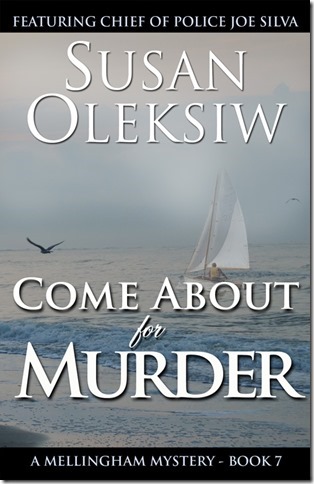
In the seventh Mellingham mystery, Come About for Murder, I open with a funeral. “In his last will and testament, Commodore Charles Jeremiah Winslow, one of the greatest yachting enthusiasts in the history of Mellingham Yacht Club, asked to be wrapped in a mainsail and cremated, with his ashes left to sink into Mellingham Bay. His family argued for six days and six nights over whether or not to comply with his wishes, but when they understood how much money was riding on this, they agreed to do as he wanted.”

This is a story about sailing, and the people who live to be out on the water. And they also clearly have the money to spend as much time as they want sailing along the east coast. To read more, go here.

Crafting a strong opening for a novel is perhaps the hardest writing but also the best. A good opening sets the stage for the story and draws in the reader. We all have our favorite opening lines, and I find myself returning to them when I’m working on my own.

Wednesday, January 11, 2017

The Daily Word Count

I’m almost exactly in the middle of my current WIP, and I know my subconscious has figured out the ending by the change in my daily word count. There are lots of signs that a manuscript is going well, but my changing daily tally seems to be one of the most reliable.

Like most other writers, I set myself a daily goal, usually fifteen hundred words. If I don’t meet this figure, I feel like I’ve been slacking off. But this is a guide, not a requirement. On some days my word count is as low as five hundred, and on other days the number can run up to six thousand.

Any figure over two thousand makes me uncomfortable because I question how good the scenes can be if I’m pushing out such a high word count. I once listened to a writer talk about his daily goal of fourteen thousand words. I wasn’t the only one in the audience who gasped. Was he really this good? Was he really that brave? He went on to explain that he felt he had to get the outlines of the story on paper. He had to see the skeleton lying on the sidewalk, in order to feel he had some control over the plot line. After he got through his first draft, which took him barely a week or two, he went back and worked through each sentence. His process sounded a lot like automatic writing. He just let the words pour out without any thought as to how good they were or whether they made any sense. This is a writer who truly had learned to shut off his inner critic.

I would never attempt to write at such a rate. But when I write only five hundred words in a day I look for a reason. There are several. First, I begin my work for the day by going back over what I’ve written the day before. I’m likely to cut lines, perhaps even an entire scene, or rewrite a crucial passage that I pondered all night. If I cut eight hundred words and add in nine hundred, my net gain is only about a hundred words. And then I write five hundred more. I guess I can say that I’ve met my quota for the day. A second reason is that I come to a passage that requires more research, so I stop to work on that. This may take all morning, leaving me less time to meet my quota, but it may also give me material that will ensure I don’t have to rewrite the passage later. A third reason is that I’m stuck. I don’t know what’s happening in the story and I have to stop and think it through. Frustrating but necessary.

In Come About forMurder, I spent a lot of time reworking the final scenes on the water. On those days my word counts were pretty low, but in the end I was satisfied. I did a lot of rewriting of the short story “Variable Winds,” in Alfred Hitchcock Mystery Magazine (October 2016), to make sure the technical information was correct and clear in very limited space. Some things just take more time.

I keep a running list of my daily word count, as well as what has happened in each scene, and both tell me if I’m on track. There are times when the daily tally doesn’t matter, but in general this is one simple guide that lets me know if I’m on track, or need to rethink the direction of my WIP.


For this and other work in the Mellingham series and the Anita Ray series, go here.

Tuesday, November 15, 2016

Developing the Protagonist

This past weekend I attended Crime Bake, the annual mystery conference held in Dedham, Massachusetts. This is a small conference with lots of panels and opportunities to meet other writers and readers. In the coming weeks I'll share some of the ideas and insights from the conference. Today I'll talk about the practice of developing a protagonist by listing 20 things you know about this character.

At first this sounds like an easy exercise. This is your novel and your protagonist, so you know all there is to know about your character. Right? Probably not. Each item or characteristic will limit what can be included afterwards, and some will have a greater impact than others. In addition, once you get past the first ten or so items, the exercise becomes more difficult. Let me work through one example, using Chief of Police Joe Silva. When we meet Joe, in Murder in Mellingham, he is already entering middle age.

1. Joe Silva is of Portuguese descent. This has implications for the kind of experiences he has had growing up and as a young man.
2. Joe is a little over average height, so he's considered tall. But his height isn't so great that he would compete with Jack Reacher, Lee Child's creation.
3. Joe is unmarried. This opens up all kinds of plot possibilities, and indeed he makes a commitment in the third book, Family Album.
4. Joe worked on his father's fishing boat. This means Joe is working class.
5. Joe is easy going.
6. Joe has a kind sense of humor.
7. Joe is the middle of seven children.
8. Joe calls his mother every week, but rarely visits his family, who live about two hours away.
9. Joe attended Northeastern University. This is a co-op school, meant for commuters as well as the working class population. He would have dressed well, jacket and shirt, perhaps even a tie, for his first week of classes. If he'd been born in a different environment, and gone to Harvard as a legacy student, he would have dressed very differently.
10. Joe is patient. No one would ever call him a hot head, and for a career policeman this is important, affecting his chances for advancement.

By this point we're going deeper into Joe's character. We could fill up the slots with personal tastes (coffee with milk), physical description (black hair and brown eyes), talents (he learned to carve from his grandfather), and childhood (he shared a room with his two brothers). But these aspects, though important details, don't tell us much about the man who is Joe Silva. This is where we have to make choices, and dig deeper for human qualities and behaviors.

11. Joe is broadminded. Having grown up as a minority and working class, he felt the sting of prejudice, and he is sensitive to how circumstances can make other people feel.
12. Family matters a great deal to Joe, so he understands the motivations of others who often make bad decisions for what seem to be the right reasons.
13. Joe is tolerant. He knows people are different simply because he grew up surrounded by siblings who were always debating and arguing and being as different as people can be.
14. Joe grew up in an old-fashioned home, and has chosen to maintain certain practices. You will not hear him call his older relatives by their first names. His uncle will always be Tio.

The deeper we go into the list, the less observable the qualities are. We are now delving into Joe's character, his way of living in and dealing with the world. These are the qualities that people come to know about another after living or working with them for a number of years. They are also the qualities that emerge in a crisis, as we follow our character through the process of discovering the murderer or confronting him or her.

15. Unless someone else's rights or standing are on the line, Joe will prefer to walk away from an argument. Life is too short to be tense with anger all the time.
16. Joe will not bear a grudge but he will keep his distance from people whose way of life repulses him, the fast-talker, the smooth-talker, the builder who cuts corners, the man who whines about his taxes but lives in a million-dollar home.
17. Joe loves his family but he vowed as a young man when he entered the force that he would not show favoritism to any friend or relative. This has not always been easy for him, but he takes it day by day if he has to, as in Last Call for Justice.
18. Joe grew up working on his father's boat and his uncle's farm, so he is physically strong, but he finds most sports a waste of time. He doesn't play golf or tennis (no one in his family did), and only signed up for track and field during high school. He was big enough for football and fast enough for ice hockey, but the violent physical contact didn't appeal to him. He'll watch a football or hockey game but he's not interested in playing.

Even though we may now think we know this character well, he can still surprise us, and we should be ready for that. Joe Silva remained unmarried well into adulthood. But when he did make a commitment, he exhibited two more qualities that are important to our understanding of him and his life story.

19. Joe is a man of fidelity. Once he makes a commitment to a life partner, he is never going to cheat on her.
20. Joe became a stepfather and discovered that he loved being a father. He had set aside his feelings about family and parenting when he didn't marry as a young man, so coming to this in his middle years has brought unexpected happiness. He looks forward to opportunities to spend time with his stepchildren, and to teach them what he knows, in Come About for Murder. 

We learn who someone is by watching his or her behavior, and the same is true in a novel. I developed Joe Silva's character through several books, but in each one I had to stay true to the original impression I created in Murder in Mellingham. In each book, however, we get to know Joe more deeply. He's not perfect, but he's a decent human being who loves his work and his family, and faces challenges squarely.


 To find the Joe Silva/Mellingham books, go here.here

Wednesday, February 3, 2016

Mallalorking

I have been using the month of January to catch up on various half-finished projects. So far I’ve polished and sent off to the final beta reader the seventh Mellingam/Joe Silva book (which I had expected to send to Five Star/Gale, Cengage before they ended their mystery line). I’ve prepared the third Anita Ray mystery for a trade paperback edition, and I’ve begun the final work on a collection of mostly previously published Anita Ray short stories, which included writing three additional stories to balance the collection. All of this feels important but it’s mostly scut work for the real task at hand.

Well over a year ago I started a novel that I hope will be the beginning of a new series. The protagonist and setting sort of arrived, and I followed them into the story. Now I’m thinking about the second book, but not very hard. I have an idea and I’ve been letting it grow, like an onion, a layer now and then. When an idea pops into my head (Oh, she could do this!) I make a note and forget it. I’ve been pushing away the story because I’m not ready to write it, but I know it’s there.

An article in The New Yorker covers the importance of daydreaming in solving problems, and every writer I know accepts the virtues of letting the mind wander. To distract myself from diving into a story too soon, when it will feel constructed and lifeless, I’ve been sorting through books for my local library’s annual book sale. My mass of photographs, which isn’t well organized enough to be called a collection, is an equally good distraction, and so far I haven’t been able to get rid of any of them. But I will.

When I arrive at an appointment early and have to wait, I engage in one of my favorite practices, mallalorking. I love that word. The Urban Dictionary offers this definition: “Acting out restlessness before a journey. It’s a Newfoundland term so most of the people you hear saying it live in the really cold parts of the US.” I never thought the term required a cold setting; it works equally well in July.

Mallalorking is that physical restlessness while the body has nothing to concentrate on except the lack of a focus. There is no train to get on, to landscape to watch through the window, no passengers to study. It is an imposed physical boredom that we know is finite. Mallalorking is also the recess between books, the time before a long period of concentration and tight focus when my unconscious has been solving a problem and gathering the many details of the solution.

Despite my productivity in January, I have really been mallalorking. During this period I’ve recalled a few incidents from the 1970s that stay in my mind and call for further research. I can feel the story growing, the characters taking shape and the surprises that are awaiting. I believe that each novel is a journey that the writer undertakes, a process of discovery and learning. The impetus is almost physical, to get out the door and onto the road, and cannot be denied. I’m delaying the point of departure to make sure I have all the materials at the ready, because once I start, there is no stopping. There will be no more mallalorking.

For the article on daydreaming, go to

http://www.newyorker.com/tech/frontal-cortex/the-virtues-of-daydreaming

For the definition of “mallalorking,” go to

http://www.urbandictionary.com/define.php?term=mallalorking