Thursday, July 20, 2017

My Grandfather's Photographs

After months of tripping over boxes of photographs, moving them from one closet to another—despite the warning, “moving them is not de-cluttering”—I have at last managed to get most of my grandfather’s photographs digitized. Because my grandparents divorced in the 1920s, when my mother was still a teenager, I hardly knew my grandfather. Now I feel I’m getting to know him for the first time, through his photographs. He lived in Washington, DC, and enjoyed showing visitors the sights when he wasn’t working. His dramatic shots of a monument are among his best, each one hinting at a story and reflecting the Art Deco style he loved.


He came of age at the beginning of the twentieth century, served in World War I, and built a career in the 1930s, working in various aspects of the dairy industry, such as “electro freezer” sales and management. He rarely photographed the typical farm, preferring instead the industrial end of the business, such as large-scale kitchens. (Who wears a fedora in a kitchen? A salesman?)


 The new automobile landscape offered many opportunities, and he left a record of the popular signs outside highway restaurants. From the looks of his collection, he did a lot of driving. I’ve never heard of some of these roadside food joints, but the names fit the post World War II mindset.


 He had a sense of humor as well. He took photos of the pets in the apartment buildings where he lived, as well as portraits of a number of neighbors and friends as well as relatives. He loved the ducks on a nearby pond and also, apparently, the neighboring deer.


I’m working on his film library for two reasons. I’m curious about what kind of photographer he was, and I’m drawn to photography in my own life. He liked to explore camera techniques, and tried various composite images, including one of himself in a striped shirt arguing with his twin over a set of cameras. I haven’t found the negative for that one yet. (Yes, the photo below is of a hand holding a wrecked car.)


But I learned something else from exploring his work. His best images are modern but also hint at a story. Even the photo of an empty room in the evening, with a book lying on a footstool and a newspaper mounding on the floor, hints at more than is captured in that one image. Along with the images, I now carry the suggested story ideas.

I have used photography as a catalyst in at least one mystery. In When Krishna Calls, Anita Ray is drawn into the disappearance of a hotel employee and the death of her husband when she discovers a message wrapped around the battery in her camera. She discovers another clue on the memory card. In other Anita Ray mysteries, she filters information from the tourists who visit her photo gallery in the resort.

There are a number of ways to use a camera and photography in crime fiction. Thanks to my grandfather’s collection (and my own and those of other relatives), I have a wealth of material to work with.

To find the Anita Ray and Mellingham novels go to:

https://www.amazon.com/Susan-Oleksiw/e/B001JS3P7C

https://www.smashwords.com/profile/view/SusanOleksiw

http://www.barnesandnoble.com/s/susan+oleksiw?_requestid=1017995


Thursday, July 13, 2017

Eye to Eye with Nature

I’m not sure what this post is about, but my experiences of being eye to eye with nonhuman creatures have been accumulating. Here are some of them.

From Alexas-Fotos, Pixabay
During my first visit to Trivandrum, the capital of Kerala in South India, I took a walk through the city-owned zoo. I was alone, with Indian families walking in front and behind me. When I came to the gorilla enclosure, which was no more than a concrete cage with bars on three sides, the animal rested in a small niche in the center of the back wall. All of a sudden, the animal rushed to the bars and stared at me. I wasn’t alarmed because there were those bars between us. As I walked on the animal followed me, moving from bar to bar until I disappeared around the corner. His face was barely three feet from mine, and he watched me every step of the way. Perhaps I smelled different or looked different. His curiosity was palpable, and I kept wondering what he was thinking.

From Stux, Pixabay
I often encountered goats during my visits in India and at farms here in New England. Their eyes, close up, are creepy. That’s the only word for it, from a human perspective, but the design has a purpose. The black slit in a yellow iris gives prey, like goats, a wider swath in which to spot predators but for the human the eye of a goat looks strange and weird. It’s hard to know what a goat is thinking when you’re eye to eye with it.


The eyes of parakeets don’t seem especially unusual, but I found myself eye to eye with an immature grackle when the bird managed to get inside the house through a tear in a screen window. It then somehow got between the upper sash and the half-opened lower one. And it couldn’t get out. As I tried to lower the sash to let it fly free, the bird struggled and made things worse, leaving me staring in the young bird’s black eye. Did it know I was trying to help? Somehow the bird managed to get out and found itself sitting on the windowsill before a now open window. It ruffled its feathers, and flew off into the back yard, its moment of terror forgotten.

Dakshini
One of the most moving encounters occurred in 2014, on my last visit to South India. On the way to a concert I stopped with friends to offer the temple elephant, Dakshini, some treats, carrots and apples. I'd done this a few times with these friends. The mahout allowed us into the enclosure, and the elephant, a female entering her senior years, is tolerant after serving in hundreds of temple festivals and rituals. I found myself next to her feeding her carrots and looking into her eye, as large as the palm of my hand. I felt both compassion for her living a life with a chain around her ankle and wondering if I should fear her. After all, I might have edibles but why would she trust me? I don’t know what she was thinking, but she watched me without blinking or lifting a foot or leg. Perhaps she sensed what I was thinking. She took the gifts from my hand with her trunk and also let me put them to her mouth.

Mahabalipuram, Tamilnad, India
I think of Dakshini often, wondering how she is and if someone else is giving her treats. I’m not one to anthropomorphize animals, but I do believe they have their own world with feelings and worries and attitudes. I won’t speculate on what she was thinking, but I will remember looking her in the eye and feeling the stillness in her as I stood only inches away, one hand on her neck and the other holding fruit. 


Throughout the centuries artists in India have depicted the elephant as a light and graceful animal. When I stood close to Dakshini, I could understand the feelings behind the art.


Tuesday, July 4, 2017

My 4th of July Tradition--The Family Flag

This post was originally written for July 4, 2016. I'm reposting it here, today, July 5, 2021, in honor of our Constitution, new President and Vice-President, and determination to preserve the Union for all people of this nation. 

In honor of the Fourth of July, I offer a story about a flag and a mystery.
One of my personal rituals is flying my mother’s family flag on certain holidays. It’s moth-eaten, torn in some places, and frayed at the ends. It also has 39 badly arranged stars. There are no neat rows, and the stars in the blue field look like they were added haphazardly. Or perhaps the designer had poor spatial skills. No matter. I found the flag in a trunk when I cleaned out my mother’s house, and didn’t think any more about it.
My mother and grandmother had a habit of labeling things. My grandmother did this because she knew she was losing her memory and wanted to pass on items of family history, such as my great grandfather’s change purse or her mother’s winter muff. My mother labeled things because she was orderly and liked to save things.
The flag came with a note on my mother’s stationery used in the 1940s, and identified the maker of the flag as her maternal grandmother, Grandmother Osborne. My mother added, “I seem to remember her sewing in the last one [star].” Hmm, no. But the flag is clearly homemade, with the stars hand stitched first and then on a sewing machine.
History buffs will already have identified the problem. The United States never had an official flag with 39 stars. In 1877, a star was added for Colorado (admitted in 1876), and the official US flag thereafter had 38 stars until 1889. But flag makers had expected Congress to accept two new states and had produced flags with 39 stars in anticipation. Unfortunately, they were stuck with an inventory they couldn’t sell. Until 1889?
In 1889, Congress was poised to accept the Dakota Territory as a state, and the assumption was that it would be one state. But, surprise, it came in as two. Those who anticipated one state (commercial flag makers) once again ended up with an inventory of flags with 39 stars they couldn’t use at all. And even if they had guessed there would be two Dakotas, Congress in its perversity accepted four more states right away (Montana, Washington, Idaho, and Wyoming), pushing the star count to 43 in 1890 and 44 in 1891. Anticipating the actions of Congress was a losing proposition (and not much has changed).
Hence, there has never been a year in which the US flag officially had 39 stars. If you find a flag with 39 stars, you know it was made before 1889.
My family’s flag, with its haphazard arrangement of stars and its inconsistent width of red and white stripes (from three to four inches) could date from 1876 or 1889, the only two years when people expected there to be 39 states and flag makers produced flags in anticipation. But in both years they were wrong.
Whatever the truth is, I may never know. Grandmother Osborne was born in 1864 and died in 1931. She might have made the flag at the age of 25, as a young married woman, but she could just as likely have inherited it from her mother, and added a star in 1889 in anticipation of the state of Dakota. I’ll never know if she created the flag or not unless I find more evidence. I’ve examined the stars, and two or three seem to have been sewn on by a different hand, but that could mean no more than two women in the family worked on the flag together, each one showing a distinctive style in her stitching.
The more I think about it, the more likely it seems to me that Great grandmother Osborne inherited the flag from her mother, Great great grandmother Beckwith, and my mother remembers her repairing it, not adding a star sometime in the 1910s.  I’m tempted (only tempted) to repair it myself sometimes.

Not all mysteries have answers, but at least I can work on this one a little every year. Right now, I’m grateful for beautiful weather and a place to hang it, on the porch. But after learning more about the history of the flag, and its rarity, I no longer leave it out unless I’m at home. As someone who grew up sewing as much as reading, I treasure something made and handled by a long line of women ancestors.

Tuesday, June 27, 2017

Changing Horses in Midstream

Today I passed page 200 in editing my current work-in-progress, and as I did so another method of murder occurred to me, along with a different murderer. This may seem a little late to be coming up with two crucial factors in a murder mystery, but instead of blotting them out of my consciousness, I stopped what I was doing and thought about it.

Like many other writers, I consider myself a pantser with a few caveats. I begin with an image of a character doing something. This is not quite a scene but close to it. I know who he or she is, mostly what they’re doing but not the implications and consequences. Who the person is in relation to the victim (or even if he or she is the victim) and the murderer isn’t yet clear. As I think about the image and how it grows in my imagination, the general outline of a story becomes clear.

I like to have the murder weapon or process be true to the setting and the characters. I don’t want to see a quiet, steely librarian suddenly whip out a gun, though that might make for a fun story. Nor do I expect longshoremen to use poison, or anything that could be considered genteel. So I was thinking up a method of murder that fit the setting, a farm in a part of rural America. I was satisfied with what I developed (and won’t mention it here because I plan to use it in another story).

And here is where the moment of inspiration comes in. It occurred to me that I had a much more appropriate method of murder that I had overlooked—perhaps because it was so obvious to someone like me (and no, I can’t say what that means). And then I thought about the admonition not to change horses in midstream. The method I’d been using made sense, it worked, and I was already in editing. But the new one made a lot more sense, implicated a lot of other innocent people, and was still true to the characters and setting. Plus it required a minimum of rewriting. I had to remove one short chapter, fewer than a thousand words, and the replacement chapter all but wrote itself.

I can’t say with one hundred percent certainty that I’ve solved every problem in switching murder methods, but I like the feel of the story I’ve produced, and I like seeing some minor characters become more interesting to the reader.


This isn’t the first time I’ve done this—changing a character in some important way in the middle of the story, combined two characters, changed locations, changed characteristics of a character—but this is perhaps the most significant one. I’m all for rules that guide the writer, ensuring a tighter, deeper, more compelling story. But I’m also all for breaking those rules when something better comes along.

Tuesday, June 20, 2017

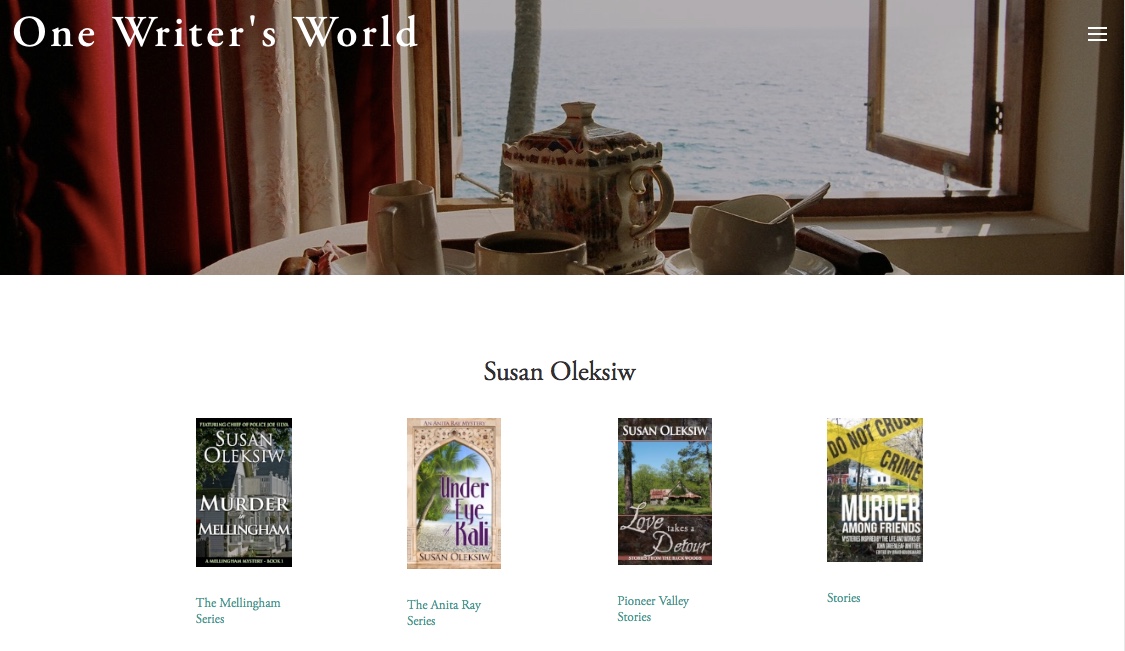
My New Website

For the past month or so I’ve been struggling to set up a new website. After my web maven died this past October, I knew I really had to learn how to do this myself. A friend who designs websites thought it would be easy for me to catch onto HTML, and another offered to help me, for a fee of course, and still others had lots of advice and references. It seemed to be as hard to pick someone to do this for me as it would be if I did it myself. I remembered how frustrating it was to keep a running list of changes or updates I wanted my web maven to make, and then I had to review the results and follow that up with a list of corrections. It was time consuming and sometimes things were never quite what I wanted. Hence, my decision to jump in. I would build a simple website and all would be well. Famous last . . .

www.susanoleksiw.com
First came all the sites that offered do-it-yourself websites for a fee, and all of the advice from those who know how to do this for free. I tried four sites. In the end I chose Squarespace.com largely because I could try out their templates over several days before paying, and the templates were easy to work with. I had twelve days to try things out. To my amazement, I had two pages after the first afternoon. Since I knew what I wanted, sort of, I figured I had enough time. In the end, I didn’t need all the time allowed.

The most serious challenge came with transferring the domain name and the other technical stuff. There were a few glitches along the way, but with the help of the support staff (I’m a new convert to live chat features) I seem to have managed. Then came the magic of “propagating,” which seems to have its own heart beat regardless of the work with Google Search Console.

I’m not sure what the point of this post is except to report that given the right tools and the right support, even a Luddite like me can manage some of the new technology. And yet all is not high-tech ultra modern. I still needed older skills, such as patience, the ability to read someone else’s shorthand, an intuitive sense of which pages to close and which to leave open, and the skill of figuring out which question to ask. I give high marks to the folks on live chat because some had to jump in in the middle of my befuddled query. But all is well—mostly. I’m still waiting for the old website pages to completely disappear, and the new ones to take over.

Overall this was a fun adventure. I got to use some of my favorite photographs, watched the software surprise me as it picked up links I worried about, and learned more than I expected to. I have a much better understanding of how the Internet works, but it’s still very basic. But the site isn’t finished (these things never are). If you see where I should change or improve things, please let me know. Now that I have learned how to get into the pages and do all the work myself, I’m glad to do so. And I'm always glad to hear other people's opinions and suggestions.

www.susanoleksiw.com